

Social justice in an ever-changing world
There is an oak tree and an apple tree, a wooden teepee, a bench and an array of brightly coloured metal instruments scattered across the open space. Along the back wall are hung silvery aluminium plates. Herbs and other plants grow in profusion. There is a rocky pathway that invites water to tumble over it – though for the time being it’s dry. The school’s sensory garden – sounds, sights, smells and sensations – is there for everyone to enjoy.
Dougie is an important member of staff. He comes into school two or three afternoons a week to support individual children by going with them for walks or just being with them in a classroom. Sometimes he will actively play with pupils, running around the playing field with a ball or if it is wet sitting quietly with them in the library. His presence is gentle, comforting and non-judgmental. Dougie is a trained therapy dog. For children who do not have access to pets, he provides opportunities to learn about animals; the affection they can offer and for some this can also mean reducing their fear.
Putting wellbeing first
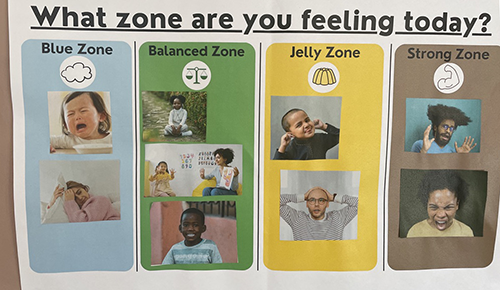
Unless a child is emotionally calm they are not in a good place to learn. Since COVID families have more worries and issues, and these big emotions often transfer to children. Adaptations need to be made, especially when they first come into school. Some need a quiet time, others some distraction or perhaps just talking about something they might find interesting. The aim is to refocus the child away from the anxiety they have brought with them and put a smile on their face. Changing the approach to a learning task may also work.
One thing we’re good at is knowing where the children are emotionally on that day … they’ve not slept very well, or they’ve not had any breakfast, or they’ve just had a really bad day … we do a phonics game rather than looking at the phonics card, so they’re still learning. (teacher)
The school knows about the social and emotional development of all pupils and who needs more support. Healthy relationships are a significant part of wellbeing and these are actively nurtured in Sutton Park. Pupils told us that it is not acceptable to be unkind to anyone. Many mentioned that they love the school because of their friendships. Teacher-student relationships were also a powerful reason for pupil satisfaction.
I love learning in Sutton Park because the teachers are very kind and help us all. (pupil year 5)
We get lots of help from grown-ups. (pupil year 4)
I enjoy learning here because humour makes it enjoyable and you can have a laugh while learning. (pupil year 6)
Engaging parents
Relationships with families are of great significance at Sutton Park. The school takes the view that if you are going to have sustainable impact on learning and wellbeing it is as important to work with the grown-ups as with the children. As some families may not have had good experiences in education themselves there is a concerted effort to establish and maintain active, positive relationships with parents and care-givers.
Because the relationships are really strong, you can have difficult conversations with people, but they’ll listen … it takes time, and it takes effort … but if you prioritise it, through that comes strong outcomes. (trust executive principal)
The Community Café was set up three years ago to establish a network for parents and care-givers. It takes place for an hour before home-time on Fridays in the main hall. With friendly staff offering tea and biscuits, the aim is to make a space where everyone feels welcome. The school arranges for representatives of various services, such as Citizen’s Advice or the Fire Service to be on hand for any questions. The school has also invited organisations that can support families with finances. There is a core of parents who attend and others who dip in and out.
Links with parents are made as soon as their child is in nursery or reception, so they can encourage their children with language and reading. Picture books are sent home with a prompt sheet about what questions to ask and activities to do. Staff model how to read with children and parents are shown a video.
My son, he’s not that academic … so they really play to his strengths … He’s not good at putting things down on paper, they’ll give him other methods to do. He’s really good with his ideas, and they really praised him, and say his ideas are absolutely amazing, and the fact that they’ve noticed that and sort of honed in on it … he’s now in year four in mainstream, and you would never know that he’s been in the language unit. (parent)
Conclusion
Sutton Park Primary serves a community that is disadvantaged in many ways. Transforming children’s ambitions as well as their achievements is aimed at facilitating greater equity in the future. This is embedded within the curriculum and the pedagogy, in enrichment opportunities, valuing pupil strengths and meeting individual needs. Strong relationships with parents, their involvement in their children’s learning, alongside ‘above and beyond’ support is part of this drive for social justice.
In conversations with parents there was a clear comparison with other schools and the difference that Sutton Park was making for their children. What happens at Sutton Park provides warmth and nurturing, alongside high expectations and support to meet these. This aligns with healthy child development and has the best outcomes for children.
She is happiest here of all the schools she’s been in. In the previous schools, the approach is like rote learning … There’s a times tables test one week, and if they didn’t get full marks, they would do the exact same test the next week and the next week until they got full marks. What we’ve seen here is each child … treated as an individual. So one of the things she was doing over the holiday was trying to write stories … even though there were spelling mistakes, her imagination is being fed … the teachers give her a personal challenge, and the way that our daughter has really risen to that is great to see. (parent)
The school he was at … he was just allowed to watch the TV and do his own thing. There were never any positives. When I came here, it was a bit of a struggle for the first six weeks, because he (had been) allowed to do whatever he wanted, and he felt he could do that here … He found it very difficult to be in a classroom environment with other people … Anyway, he’s absolutely thriving … He’s joining in, he’s got friends. He just thoroughly enjoys coming to school. He’s so happy. They’ve worked so hard with him, I could cry. (foster parent)
Every member of the team is warm, friendly, approachable and caring, while maintaining the highest levels of professionalism. They do an outstanding job in supporting teaching and learning, creating an environment where children feel happy, safe and motivated to succeed. (parent)
All grown-ups are kind and nice, nobody’s mean. As soon as I come to school I feel happy. Teachers always try and make the lesson fun for everybody. Everything is fair. (pupil year 4)
There will be much more information about this and the other nine schools in the project in the forthcoming (2027) book, Inspiring Children’s Love of Learning: Exceptional Practice in Primary Schools (Routledge).





Leave A Comment
You must be logged in to post a comment.