

Transformation, Innovation, Inclusion
The truck rocked slightly as it was relieved of the weight of a huge static caravan. The mobile crane, steady on massive support legs and with arm fully extended, slowly raised the vehicle above the roofs of the closely packed terraced houses that hemmed in the school. The boom swung very gently, and then slowly, delicately, lowered its burden into the playground. Norman Street Primary School now had its new base for children with severe learning difficulties and taken a further step to becoming a fully inclusive school.
Behaviour
The original behaviour system used yellow cards and red cards for misdemeanours with loss of ‘Golden Time’ at the end of the week. By Friday children had often forgotten why they were being sanctioned. As it wasn’t clear what the rules were. there were glaring inconsistencies. There was considerable discontent among the parent body about the system and children were often confused and even frightened.
This system really stressed out my son. (parent)
Over the course of a month the school analysed how the red and yellow card system worked in practice. Who got what when? At the same time, parents completed a questionnaire. Most felt their children didn’t understand the system and nor did they, and some thought it shaming. When the results of these analyses were shared with staff they all agreed they couldn’t continue as they were.
(The headteacher) stopped the use of the red/amber/green behaviour system which was fantastic … The teachers are using positive language with the children and seem open to learning different behaviour strategies. (parent)
Time was devoted to developing a new policy. Staff began by discussing what was good about Norman Street School and what sort of things worked for their children. Ele said to the staff, “You know the children, I don’t. You tell me what works.” Their discussion kept coming back to relationships, how to develop and strengthen them. There were impassioned staff meetings where people discussed behaviours in the classroom; how they should be managed, and the emotional response the behaviour elicited in each individual.
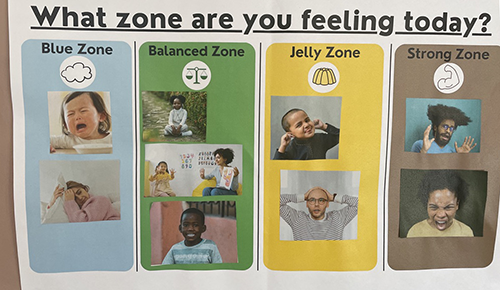
Staff discussed how to make the day begin more smoothly and how teachers could get to know their children better. Whereas all would be aware what reading level a child was at, some teachers would also know what football team they supported, the breakfast they’d had and the name of their dog. It was agreed that the children would line up to come in, checking in with the teacher as they entered the classroom. On the door would be the four zones of regulation, indicating different emotions and the child would point to the zone they were in.
All do a little check in where they touch the door when they come in, just so they can let you know how they’re feeling, if they’re tired, or if they’re fine. We do that every time they come into the classroom. (teacher)
Having registered, the children all do the ‘Daily Mile’ – a loop around the playground and outside the school building which repeated measures a mile. Children can run or amble it while chatting to friends or their teacher. As well as physical activity, fresh air, exercise and promoting good mental health, it is a time for teachers to deepen their knowledge and relationships with their pupils. Lunch was another period identified for building these relationships. The noise and commotion in the school hall at lunchtimes was triggering for children in any way dysregulated or on the autistic spectrum. It was decided that classes would have lunch in their own classrooms, eating in calmer conditions while chatting with friends and their teacher.
I serve the children in my class and then sit down to eat with them. This is a great chance to chat and find out about their lives beyond the classroom. (teacher)
We know our children so well, we know something’s not right … you pick up on it really quickly, and then you’re able to get to the root cause of what’s going on. Is it something’s happened at home? Have they not had breakfast? Is something happening at the weekend they’re worried about? (teacher)
There are only three rules for behaviour in the school: ‘be safe, be respectful, be ready’. This new approach to behaviour, together with changes to the curriculum, pedagogy and inclusion, took place concurrently. In a comparatively short time, a new culture was established with the staff embracing it, taking control of it and often developing it. Everything was talked about and there was no shame in admitting difficulty. Changes were implemented with a spirit of openness, kindness, sharing and co-operation.
I feel like everyone here has such good relationships with the kids … because they care, … especially some of the really vulnerable children … Then whatever that adult does with them, they love it. Whether it’s Maths or English, they just love spending that time with the adult. (teacher)
Inclusion
A major cause of poor behaviour was that special needs were not being addressed as well as they might have been. Numbers were growing and the resources available to meet their needs dwindling. And the SENCo had just half a day to keep on top of the paperwork. Everything SEN related needed reviewing. Relieved of class teaching, the SENCo was able to get to grips with identifying and managing the range of special needs in the school.
While most special needs would be addressed in mainstream classrooms, it was recognised that something extra was needed. Two specialist or enhanced provisions were created within the school – a development for which they received no additional financial support from the LA.
- The Eden is a provision for children with social, emotional and mental health issues, where children are nurtured and where they feel safe and valued. Each child’s unique story is understood and their social and emotional development prioritised. There is commitment to both seeing behaviour as communication and reflecting on practice, analysing the current needs of the child. Children move freely between the enhanced provision and mainstream classrooms.
- The other enhanced provision is in the caravan described at the beginning of this chapter. It is called the Bothy and is for children with multiple or severe learning difficulties. There had been no suitable provision for this group and their families wanted them to stay local and with their peers. In a safe and predictable environment, with trusted adults using visual and sensory techniques, these children are making progress with their learning and are still in their local school.
Conclusion
It takes between three and six years to turn a school around and create a culture of high expectations. In Norman Street this transformation was rapid and came simultaneously on all fronts – behaviour, inclusion, curriculum, pedagogy, enrichment. Progress in each area was dependent on progress in every other area.
In many ways the school is typical of schools in England with a mixed social intake and average levels of deprivation. It is, however, challenged by significantly higher levels of SEND children. It attracts these because it is spectacularly good at providing for them. A few years ago it could have been considered to be ‘coasting’ – that is providing a satisfactory education but not actively engaging children in a love of learning. Under new leadership staff found an ambition in themselves to reach for the stars and make their school the very best it could be.
We had huge problems with N … when she was at preschool, couldn’t get to go, the screaming, the clinging on, … she’s like a different child now, she’s so happy, and last night I asked her what she loved about the school, and she said she loves the learning, like she just wants to learn everything. (parent)
We’ve got staff with passion, – people who are really passionate and caring about their areas of expertise, whether it be music or sports or reading, or our residential package. People really want the best for the children, and then our interests impart onto the children as well. It is somewhere we’re proud to work, and we see that the kids get a really good deal. (teacher)
If you look after the child, that allows them to learn. We care about the kids highly, and that then transpires into a love of learning, because we do make them feel safe, we make them feel wanted, we make them feel like they are part of our family and our community, and then the love of learning follows that. (teacher)
There will be much more information about this and the other nine schools in the project in the forthcoming (2027) book, Inspiring Children’s Love of Learning: Exceptional Practice in Primary Schools (Routledge).



Leave A Comment
You must be logged in to post a comment.