


This section lists publications by Growing Great School’s Director, Sue Roffey, and our Partners
For other relevant publications, you can also go to the Resources section:
- resources you can use in Circles: books, and cards etc
- the resources that Circle Solutions Trainers use – regularly updated
- a selection of the Handouts we have provided at previous talks and courses.
Publications by Sue Roffey
This section lists publications by Sue Roffey, or you can download a PDF list of her publications to date here: Sue Roffey Publications 2024
Forthcoming in 2027
Handbook on Wellbeing in Education: Research transforming practice (Elgar Handbooks in Education): edited by Sue Roffey and Ansie Kitching, this comprises 34 chapters from practitioners and researchers all over the world.
How to Grow Great Kids: A Positive Behaviour Guide for Parents and Carers (BPS Ask the Experts Series: Routledge): does what it says in the title!
Inspiring Children’s Love of Learning: Exceptional Practice in Primary Schools (Routledge): more information on this at The Love of Learning Project.
Published
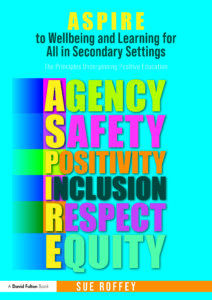
 Aspire to Wellbeing and Learning for All in Early Years and Primary and Aspire to Wellbeing and Learning for All in Secondary Settings by Sue Roffey (2024). Sue shows how to create a learning environment where all pupils can thrive and make progress in learning, and where wellbeing for everyone is at the heart of every school. By using the unique evidence-based ASPIRE principles of Agency, Safety, Positivity, Inclusion, Respect and Equity in practice, this insightful book shows teachers how to redress the balance in ways that maximise a love for learning, build a positive sense of self, construct healthy relationships, foster resilience and help young people make good choices. This resource features a chapter for each principle which explores what this means, why it matters and how it can be applied across secondary schools. Although visionary, the books are based on both substantial evidence and good practice, with each chapter supported by case-studies across the world. The books demonstrate the positive difference each principle makes to children as well as teachers, parents and the overall community. A must-read teachers, tutors, school leaders, psychologists, parents and anyone who wants an education system that is inclusive, holistic and effective for all students. More information here.
 Creating the World We Want to Live In: How Positive Psychology Can Build A Brighter Future, by Bridget Grenville-Cleave, Dóra Guðmundsdóttir, Felicia Huppert, Vanessa King, David Roffey, Sue Roffey and Marten de Vries (2021). This book is about hope and a call to action, to make the world the kind of place we want to live in. It aims to provoke conversation and positive change, and may challenge long-held views and extant ideologies. The book explores the principles that underpin living well, and gives examples of how this can be achieved not just in our own lives, but across communities and the planet we share. Chapters cover the stages of life from childhood to ageing, the foundations of everyday flourishing, including health and relationships, and finally wellbeing in the wider world, addressing issues such as economics, politics and the environment. Based in the scientific evidence of what works and supported by illustrations of good practice, this book is both ambitious and aspirational. The book is designed for a wide audience – anyone seeking to create positive change in the world, their institutions or communities. More information here.
 The Third Edition of Circle Solutions for Student Wellbeing, by Sue Roffey (2020). Completely revised, bringing in to line with the ASPIRE principles, and adding many new games and exercises, including some for working on challenging subjects such as gangs and radicalisation.
Schools and others who wish to buy multiple copies (more than 10) can get a discount of up to 40% by emailing Despina McLaren at Sage: despina.maclaren@sagepub.co.uk.

The Primary Behaviour Cookbook and Secondary Behaviour Cookbook, by Sue Roffey (2019).
Developed in conjunction with practitioners and teachers, The Primary Behaviour Cookbook provides highly effective, practical strategies for responding to and resolving behavioural issues in primary classrooms.
Consisting of over forty ‘recipes’, the book’s unique format enables practitioners to quickly and easily access information and advice on dealing with specific behaviours. Each ‘recipe’ details strategies and interventions for immediate application in the classroom setting, considers possible causes of the given behaviour and offers helpful approaches for responding to the child’s needs in the longer term. From disengagement to impulsivity, attention-seeking, defiance, bullying, anxiety and aggression, the book’s five sections cover a broad spectrum of behaviours falling within five broader categories:
- Getting things done: supporting positive student engagement and achievement
- Dealing with disruption: increasing motivation and skills to facilitate learning
- Social interactions: resolving problematic situations that occur between pupils.
- Emotional distress: understanding distress and developing coping strategies
- Behaviours of special concern: recognising behaviours associated with autism, trauma, or abuse.
Underpinned by positive psychology, and emphasizing the importance of constructive relationships, communication, inclusion and child wellbeing, this is an indispensable resource for primary school teachers and assistants, behaviour support consultants, SENDCOs and educational psychologists.
Read a review of The Primary Behaviour Cookbook in The Educational and Developmental Psychologist (published by the Australian Psychology Society):
The author’s skilful use of uncomplicated, jargon-free, and unassuming language makes this text accessible to teachers, teaching assistants, behaviour support consultants, and psychologists. The structure of each intervention can be comfortably assimilated with each ‘recipe’ easy to digest, regardless of the reader’s professional background.
The Secondary Behaviour Cookbook develops and extends the range of recipes for older students, in particular adding a sixth section on:
- Coping with Conflict: addressing conflict in and out of the classroom, including aspects of bullying and discrimination
 Circle Solutions for Student Wellbeing, by Sue Roffey, Sage (2014)
NB: Although the new 3rd Edition is now out, the revised edition has many new activities, so the 2014 edition will still be relevant for the games etc included in it that are no longer in the new book.
‘This is a very practical guide to a teaching approach that enables children to become more powerful learners; it is also an opportunity to spend time with a big-hearted person who understands what happens for children in school and how circles can help them grow.’ – James Park, PROGRESS Director, Human Scale Education (www.progress-hse.org)
‘Grounded in contemporary research, Roffey ignites the reader’s conviction that ‘I can do this too!’ Gifting the educator with a treasure chest of fresh, engaging, practical and applicable ideas, this book makes it possible for every teacher to build both the learning and well-being of all young people.’ – Kerry Bird, Project Manager for Personal and Social Development Education in Catholic Education – Cairns and Brisbane
First published as Circle Time for Emotional Literacy, this new edition has been updated to reflect how the Circle Solutions philosophy and pedagogy can be used to build relationships and resilience for children and young people. Putting current research on wellbeing into practice, Circle Solutions for Student Wellbeing addresses issues not incidents, solutions rather than problems, and strengths rather than deficits, providing a framework for student engagement and learning. Activities and games included in the book promote positive communication skills, empathy and connectedness, class cohesion and co-operation, friendship skills and ethical behaviour. The book is suitable for all phases of education.
 Special Needs in the Early Years (3rd Ed.) by Sue Roffey and John Parry, Sage (2014)
This highly popular and accessible text contains a wealth of information about how early years staff can work effectively with professionals and parents to help identify and meet a range of special educational needs. This book aims to explore the most effective ways of supporting the child and implementing that support across the child’s day to day life. Now in its third edition Special Needs in the Early Years is fully updated to reflect current policy, and topics covered include:
- Early identification
- Effective communication with parents and carers
- An exploration of the legal context
- How to implement joint planning for identified needs
- A consideration of the issues affecting collaboration
With case-studies, checklists, suggestions for good practice and cartoons to illustrate and enrich the text throughout, this book is structured to be easily accessible and invaluable for those who are in training to work in the early years sector. It will also be of interest to students on foundation and undergraduate students on Early Childhood Education and childcare courses as well as more experienced practitioners.
 Positive Relationships: Evidence Based Practice across the World by Sue Roffey (Ed.), Springer (2013) is available in both hardback and paperback and as a Kindle edition from Amazon. Relationships are threaded through every aspect of our lives, at home, at school, at work and at play. They are the foundation of our greatest happiness but can also be the cause of our deepest despair. Despite how crucial they are, we may not give much thought to relationships except when they go wrong – whether this is lost intimacy, violence in our communities or toxic working environments.
This highly accessible book takes a positive psychology approach to explore why healthy relationships are important for resilience, mental health and peaceful communities, how people learn relationships and what helps in developing the positive.
There is something here for everyone in both their personal and professional lives – and for students who anticipate working with people in any capacity. Chapters provide a wealth of evidence on promoting optimal interactions between couples, friends, parents and children and community groups. Authors address positive environments at work and at school, mentoring relationships, a new paradigm for relational leadership and how to foster tolerance between people of different faiths. Others explore what is best for children after family breakdown, how to ensure that conflict is more about learning than losing and what might help repair relationships that are damaged. Authors are academics and practitioners from across the world providing both evidence-based practice and practice-based evidence. Examples and case-studies throughout each chapter illustrate what works.
Overarching themes include seeking what we have in common rather than what divides us, fostering positive communication practices, building social capital and what it means to treat each other with respect. The science of positive psychology shows that relationships can offer real meaning and sustainable fulfilment in our lives. Knowing what promotes the positive is the first step to authentic wellbeing.
 Changing Behaviour in Schools: Promoting Positive Relationships and Wellbeing, by Sue Roffey, Sage (2011)
Good teachers know that positive relationships with students and school connectedness lead to both improved learning and better behaviour for all students, and this is backed up by research. This book will show you how to promote positive behaviour and wellbeing in your setting. Taking an holistic approach to working with students, Sue provides examples of effective strategies for encouraging pro-social and collaborative behaviour in the classroom, the school and the wider community. Chapters look at the importance of the social and emotional aspects of learning, and ways to facilitate change.
Read the Introduction chapter here. You can also read some reviews of Changing Behaviour here.
 The New Teachers Survival Guide to Behaviour by Sue Roffey, Sage (Second Edition 2011). Foreword by Bill Rogers.
This shows how new teachers might get maximum professional satisfaction by having an authoritative relationship with students. It suggests ways to deal with conflicts and confrontations which do not undermine a sense of self or purpose so that they become just part of the challenge, not the reason to dread Monday mornings. There are also ideas on maximising emotional resources – and looking out for supportive colleagues. See the (2004) chapter on establishing good relationships with your students, You and Your Class. This does not include Nic Watt’s great illustrations but you can see some of his excellent work and contact him here. You can read the Introduction chapter to the Second Edition here.
Review on Behaviour UK: “This book should be handed to each teacher training graduate before they enter the classroom. Ideally it should be a recommended text whilst they are still training to teach.”
Review in Nurturing Potential 15: “The book is clear, easy to read and full of solid guidance about what to do even in the most difficult situations.”
Hear Sue discussing the book on ABC Radio National’s Life Matters with Julie McCrossin (2MB mp3 file): Life Matters ABC RN
and on ABC702 Sydney (1MB mp3 file): Interview with ABC702 Sydney
Hear Sue sort of discussing the book on 2SM Sydney with a talkback host who only wants her to say that teachers are just there to deliver the curriculum like they did in the good old days. (2MB mp3 file). Interview on 2SM
 Helping with Behaviour: Establishing the Positive and Addressing the Difficult, by Sue Roffey, published by Routledge Falmer (2005) in an Early Years series co-produced with Nursery World:
This book shows how to establish good practice in early years settings so that all children are supported in developing positive interactions with one another. Sue explains the features of an ’emotionally literate’ environment in order to meet the needs of more vulnerable children and looks at how to respond effectively when children are distressed and hard to manage, providing plenty of ideas and inspiration throughout. Read the chapter Once again with feeling.
For more detail see the Routledge site or Amazon, who also have a Kindle edition.

Whole Child is a program for three primary levels with five themes: Emotions, Getting Along, Family and Community, Citizenship and Human Rights, Health and Wellbeing. Each theme for each level has two posters and a story to stimulate discussion and reflection. The teachers’ resource books (written by Sue Roffey) use guided questions and Circle Time activities to explore meanings for students. It goes to the heart of the individual within their class and their community. It addresses issues that are critical for our young people and their future – and the future of their world.
Plans for Better Behaviour in the Primary School: Management and Intervention, by Sue Roffey & Terry O’Reirdan, David Fulton (now Taylor & Francis) (2003)
This book has been completely updated and rewritten for the new Primary Behaviour Cookbook.

School Behaviour and Families: Frameworks for Working Together, by Sue Roffey, David Fulton (2003)
This book focuses on the relationship that school have with parents and carers, especially in the early stages of behavioural difficulty. It includes chapters written by contributors who have a special expertise in working with parents who harm their children, the carers of children in foster families and residential homes, mobile families and families from diverse communities. It aims to promote the best possible partnership with parents in what is often a sensitive and emotional situation.
“An illuminating exploration of the relationships between schools and families…in particular families in which there the child has behavioural difficulties” Times Educational Supplement
 Young Children and Classroom Behaviour: Needs, Perspectives and Strategies by Sue Roffey & Terry O’Reirdan, David Fulton (2001), also published in Spanish (2004) as el comportamiento de los más pequeños, Madrid, Narcea
This book shows how teachers can encourage children to learn positive attitudes and engage in appropriate classroom behaviour from the outset. It considers ways to minimise disruptive behaviour and encourages a range of useful perspectives on behaviour and young children in school. These are supported by practical easy to implement strategies. This book has been ‘highly recommended’ by teachers in a survey for the General Teaching Council. UK.
” Here is an essential text for infant and primary colleagues. It is well written, realistic, practical and useful and readable … overall this is an excellent text, indispensable for infant teachers”– Bill Rogers.

Young Friends : Schools and Friendship, by Sue Roffey, Tony Tarrant & Karen Majors, Cassell (1994), also published in Danish (2000) as Er Du Min Ven, Copenhagen, Dansk Psykologisk
This book sets out to explore the different social contexts that children find themselves in at school. It aims to link principles and theory with practical application by providing a positive social climate in an educational setting. Now out of print.
 2025: Sue Roffey: The Consequences of Loneliness for Young People, in Md Zahir Ahmed (Ed.), Loneliness – The Ultimate Suffering in Modern Society. Intechopen. [Full article available for free download]
 2023: Sue Roffey: Applying Positive Psychology in Primary Schools, in Andrea Giraldez-Hayes and Jolanta Burke (Eds.) Applied Positive School Psychology, Routledge.
2021: 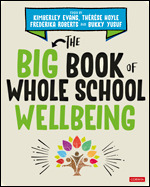 Sue Roffey: Social and Emotional Learning – Circle Solutions and ASPIRE, and Relationships and social capital, in Kimberley Evans, Thérèse Hoyle, Frederika Roberts & Bukky Yusuf (Eds.) The Big Book of Whole School Wellbeing, Corwin.
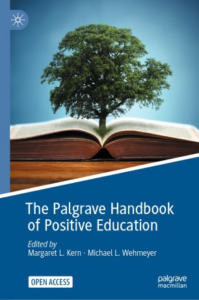 2021: Sue Roffey & Denise Quinlan: Positive Education with Disadvantaged Students, and Kelly-Ann Allen, Christopher Slaten, Gökmen Arslan, Sue Roffey, Heather Craig & Dianne Vella-Brodrick: School Belonging: The Importance of Student and Teacher Relationships, in Margaret Kern & Michael Wehmeyer (Eds.), The Palgrave Handbook of Positive Education. Palgrave Macmillan.
 2020: Dobia, B., Arthur, L., Jennings, P., Khlentzos, D.S., Parado, R.H., Roffey. S. & Sheinman, N.: The Implementation of Social-Emotional Learning, in N.C. Singh & A. Duraiappah (Eds.), Rethinking Learning: A Review of Social and Emotional Learning for Education Systems (pp.157-186) Unicef/MGIEP.
 2019: Sue Roffey: Relationships & Social Capital in Schools, in Castelli et al. (Eds.), Wellbeing in Education Systems, Conference Abstract Book (4.3MB pdf). Locarno: Scuola universitaria professionale della Svizzera italiana (SUPSI).

2018: Sue Roffey & Christopher Boyle: Belief, belonging and the role of schools in reducing the risk of home-grown extremism, in Kelly-Ann Allen and Christopher Boyle (Eds.), Pathways to Belonging: Contemporary Research in School Belonging. Leiden: Brill.
 2017: Sue Roffey: Positive Relationships at Work, in Lindsey Oades, Michael Steger, Antonella Della Fave & Jonathan Passmore (Eds.), The Wiley-Blackwell Handbook of The Psychology of Positivity and Strengths-Based Approaches at Work. Chichester: Wiley Blackwell.

2017: Sue Roffey: Learning Healthy Relationships, in Carmel Proctor (Ed.), Positive Psychology Interventions in Practice, Dordrecht: Springer.

2017: Sue Roffey: Young people’s wellbeing within schools: Student voice and agency, in Julia Hardy & Charmian Hobbs (Eds.), Using qualitative research to hear the voice of children and young people: The work of British educational psychologists (pp. 83-93). Leicester: British Psychological Society

2016: Brenda Dobia & Sue Roffey: Respect for Culture – Social and Emotional Learning with Aboriginal and Torres Strait Islander Youth – chapter in Martin, Frydenberg & Collie (Eds.) Social and Emotional Learning in Australia and the Asia-Pacific. Dordrecht: Springer.

2016: Sue Roffey: Behaviour: Chapter 13 of A guide to early years and primary teaching, edited by Dominic Wyse & Sue Rogers: the download here is an earlier draft that contains the References that were unintentionally omitted from the published copy: Ch 13 Behaviour Draft submission
2016: Sue Roffey: Circle Solutions og understøttet læring, in René Kristensen & Thomas Szulevicz (Eds): Understøttende undervisning og læringsmiljøer. Forlaget Dafolo

2014: Sue Roffey: two chapters: Growing Great Kids, and Learning to Live Together, in Helen Street & Neil Porter (Eds.) Better Than OK: Helping Young People to Flourish at School and Beyond. Fremantle, WA: Fremantle Press

2014: Volume 6 of the Complete Handbook of Wellbeing, on Interventions and Policies to Enhance Wellbeing (Edited by Felicia Huppert & Cary Cooper): Sue Roffey co-authored a chapter with Professor Jacqueline Barnes on ‘Community change- the complex nature of interventions to promote positive connections‘.

2010: Sue Roffey: Classroom support for including students with challenging behaviour, in Richard Rose (Ed.), Confronting Obstacles to Inclusion. London: David Fulton
2009: Sue Roffey: 2 Invited chapters in M. Bhatnagar (ed) Emotional Literacy: Concept, Application and Experiences. Hyderabad, India: Icfai University Press
2026: Rhoda Lai, Jennifer Southam, Luella Mageean, Sue Roffey & Kelly-Ann Allen: Associations Between Teacher-Student Relationship Quality and Middle and Secondary School Teachers’ Wellbeing: A Systematic Review. Educational Psychology Review, 38(4).
2023: Sue Roffey: ASPIRE to a better future: The Impact of the Pandemic on Young People, and Options for Schools Post-COVID-19. Education Sciences, 2023, 13, 623
2021: Ziggi Ivan Santini, Veronica Pisinger, Line Nielsen, Katrine Rich Madsen, Malene Kubstrup Nelausen, Ai Koyanagi, Vibeke Koushede, Sue Roffey, Lau Thygesen & Charlotte Meilstrup: Social Disconnectedness, Loneliness, and Mental Health Among Adolescents in Danish High Schools: A Nationwide Cross-Sectional Study, Frontiers in Behavioral Neuroscience, 15
2019: Sue Roffey, Christopher Boyle & Kelly-Ann Allen: School belonging – Why are our students longing to belong to school?, Guest Editorial, Educational & Child Psychology, 36(2)
2019: Brenda Dobia, Roberto Parada, Sue Roffey & Madelaine Smith: Social and emotional learning: From individual skills to class cohesion, Educational & Child Psychology, 36(2)
2017: Sue Roffey: The ASPIRE Principles and Pedagogy for the Implementation of Social and Emotional Learning and the Development of Whole School Well-Being, in International Journal of Emotional Education, 9(2): 59-71
2017: Sue Roffey: ‘Ordinary magic’ needs ordinary magicians: The power and practice of positive relationships for building youth resilience and wellbeing, in Kognition & Pædagogik 103 (Spring 2017) – Danish version can be found here: http://dpf.dk/produkt/tidsskrift/kognition-paedagogik-nr-103
2016: Sue Roffey: Building a case for whole-child, whole-school wellbeing in challenging contexts, in Educational and Child Psychology 33 (2)
2016: Anne Greig, Tommy MacKay, Sue Roffey & Antony Williams: Guest editorial: The Changing Context for Mental Health and Wellbeing in Schools in Educational and Child Psychology 33 (2)
2015: Sue Roffey: Becoming an agent of change for school and student wellbeing, in Educational and Child Psychology 32 (1)
2014: Anne Greig, Charmian Hobbs & Sue Roffey: Education & Child Psychology, 31(1), Empowering Young People: Editorial
2014: Brenda Dobia, Gawaian Bodkin-Andrews, Roberto Parada, Virginia O’Rourke, Shirley Gilbert, Annie Daley & Sue Roffey: Aboriginal Girls Circle: enhancing connectedness and promoting resilience for Aboriginal girls: Final Pilot Report
2013: Sue Roffey & Florence McCarthy: Circle Solutions: a philosophy and pedagogy for learning positive relationships. What promotes and inhibits sustainable outcomes? in International Journal of Emotional Education, 5 (1) 36-55
2013: Sue Roffey: Inclusive and exclusive belonging – the impact on individual and community well-being, in Educational and Child Psychology 30 (1)
2012: Sue Roffey: Pupil wellbeing – Teacher wellbeing: Two sides of the same coin? in Educational and Child Psychology 29 (4)
2011: Sue Roffey: Enhancing Connectedness in Australian Children & Young People in Asian Journal of Counselling, 18 (1 & 2) 15-39. Reprinted here with permission from AJC.
2010: Sue Roffey: Content and context for learning about relationships: A cohesive framework for individual and whole school development in Educational and Child Psychology 27 (1). Sue co-edited this special issue on In-school Relationships and their Outcomes. You can download all 12 articles here.
2009: Robyn Hromek & Sue Roffey: Games as a pedagogy for social and emotional learning. ‘Its fun and we learn things’ Simulation and Gaming 40 (5) 626 – 644
2008: Toni Noble, Helen McGrath, Sue Roffey & Louise Rowling: A Scoping Study on Student Wellbeing Department of Education, Employment & Workplace Relations (DEEWR), Australian Commonwealth Government
2008: Sue Roffey: Emotional literacy and the ecology of school wellbeing in Educational and Child Psychology 25 (2) 29-39
Sue co-edited this special issue on Psychological Wellbeing.
2007: Sue Roffey: Transformation and emotional literacy: The role of school leaders in developing a caring community, in Leading and Managing 13 (1) 16 – 30
2005: Sue Roffey: Respect in Practice: the challenge of emotional literacy in education. Peer reviewed paper for AARE conference (Australian Association for Research in Education)
2005: Sue Roffey & Michelle Nemec: Emotional literacy and whole school change. Australian Association for Research in Education.
2004: Sue Roffey: The home-school interface for behaviour: A conceptual framework for co-constructing reality, in Educational and Child Psychology 21 (4) 95-108
2000: Sue Roffey: Addressing Bullying: Organisational Factors from Policy to Practice in Educational and Child Psychology 17 (1)
1997: Sue Roffey, Tony Tarrant & Karen Majors: Friends, who needs them? in Educational and Child Psychology 14
2024: Sue Roffey: ASPIRE to wellbeing and learning for all: The Psychologist (BPS), 3/6/24
2023: Andrew Speight and Sue Roffey: A holistic approach to mental health and education: Local Government Association
2021: Sue Roffey: articles around the publication of Creating the World We Want to Live In:
- Yahoo Lifestyle: https://uk.style.yahoo.com/average-age-children-ask-lifes-big-questions-and-how-to-answer-123019364.html
- Silver Magazine: https://silvermagazine.co.uk/are-you-a-good-friend-how-lockdown-has-changed-friendships
- Yahoo Life! https://uk.style.yahoo.com/world-friendship-day-how-to-rebuild-friendships-post-lockdown-070032701.html
- Your Coffee Break: https://www.yourcoffeebreak.co.uk/lifestyle/26338792367/what-does-a-happy-life-look-like/
- Independent Education Today: https://ie-today.co.uk/comment/growing-good-men/
- Childcare Club: https://www.mortonmichel.com/news/wholeness-rather-than-happiness
- Daily Mail Online: https://www.dailymail.co.uk/femail/article-9909013/The-myth-happiness-Psychologist-reveals-secret-living-content-life.html
- Female First: https://www.femalefirst.co.uk/books/how-to-avoid-sabotaging-your-relationships-1316610.html
2018: Sue Roffey: Children and trauma
2017: Sue Roffey: Creative Caring for Teachers: How a whole-school well-being approach can support everyone’s mental health – article for Education Canada
2017: Sue Roffey: theconversation.com/four-things-schools-can-do-to-help-tackle-extremism-and-radicalisation – article following the Manchester and London attacks
2016: Sue Roffey: Wellbeing as Core School Business – What it is and Why it Matters – in networkofwellbeing.org
2014: Sue Roffey: Pushed out or pulled out? Why kids don’t want to go to school – article in The Conversation
2014: Sue Roffey: Wellbeing begins with ‘We’ – article for Open Forum
2009: Sue Roffey: Effective and Flourishing: Making a real difference by developing school and student wellbeing. Article for Principal Matters
2007: Sue Roffey: Oppositional? yes, defiant? yes, disordered? Who says? DECP Debate.
2007: Sue Roffey: Raising Achievement Update Taking Account of Emotions in Student-Teacher Relationships
2006: Sue Roffey: EQ Australia: Learning to Care: Relationships, emotional literacy and wellbeing.
2005: Sue Roffey: Series of monthly articles on young children and behaviour in Nursery World magazine. Some now reprinted in Early Childhood. Read Beliefs and Behaviour
2005: Sue Roffey: Emotional Literacy: what is it and what can it do? Article in Classroom(Australia)
2001: Sue Roffey: The Emotion in Learning in EQ Australia
1997: Sue Roffey: What to do if a Child in Your School Dies. Guidance for Head teachers published by the London Borough of Haringey.
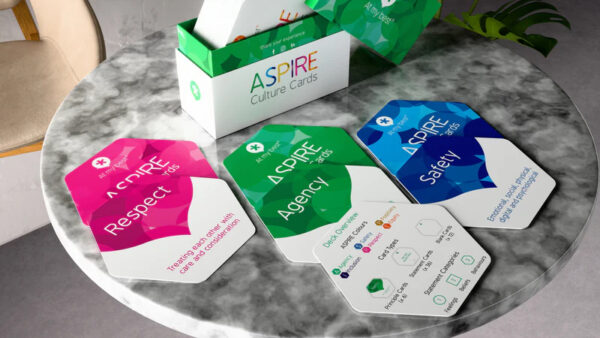
ASPIRE culture cards
For use in the workplace, classroom or community, these cards are a simple but powerful way to facilitate conversations that will change behaviour. Underpinned by Dr Sue Roffey’s ASPIRE model, this is a robust tool with many potential uses. Complete with instructions and ideas to get you started, as well as more exercise guides online, the ASPIRE Culture Cards can be used in 1-1s or with groups, for short conversations or to provide structure to meetings and workshops.
What’s in the box?
- 6 x Principle Cards, each with a helpful definition
- 36 x Statement Cards, covering beliefs, feelings and behaviours
- 12 x Blank Cards to tailor your conversations
- An Introductory Booklet to get you started.
To view and order the ASPIRE Culture Cards – atmybest.com/pages/aspire-culture-cards – 20% discount with the code EdInstitution20
Learning to be, learning to live together: Rethinking Education with James Mannion & David Cameron
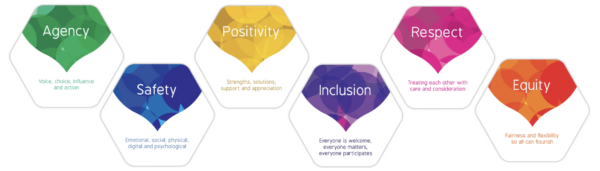
In this episode, James and David are joined by Sue Roffey – educational psychologist, researcher, and leading voice on wellbeing, social justice, and relational approaches to education. Sue traces her journey from working with young people facing emotional and behavioural challenges, through educational psychology and academia, to her current work developing the ASPIRE principles – a framework for reimagining education through agency, safety, positivity, inclusion, respect and equity. The conversation explores why wellbeing and learning are not competing priorities but deeply intertwined, and why many current approaches to behaviour and school improvement miss this fundamental point.
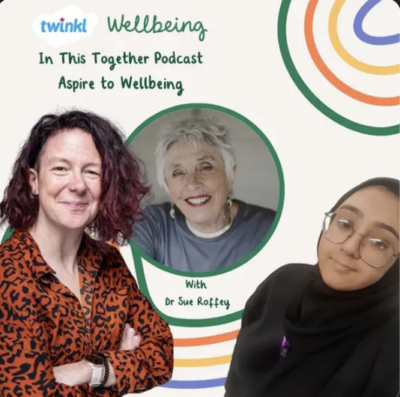
ASPIRE to wellbeing | Podcast episode for Twinkl’s In This Together
Becky Dawson talks with Dr. Sue Roffey about the essential connection between wellbeing and achievement in education. The discussion centres on Dr. Roffey’s book, Aspire to Well-being and Learning for All.
Creating Flourishing Cultures in Education: An Introduction to ASPIRE: Webinar recording
This is a recording of the webinar held on 24 Nov 2025, where Dr Sue Roffey was our guest. Dr Roffey chats to Michele about her ASPIRE model and how it can be applied to help staff and students to flourish. We also take a first look at the ASPIRE Culture Cards and share some of the many ways they can be used. More info here: https://atmybest.com/pages/user-hub-aspire-cards
Smiles, Safety and School Culture | Podcast episode for PESA’s The Future We Shape
“In this episode of The Future We Shape, we explore the power of belonging, connection, and psychological safety with two inspiring leaders in education, Sue Roffey and Nicole O’Brien”
Shaping Behaviour in the Early Years | Managing the Challenging
Webinar for Parenta – part 2
Shaping Behaviour in the Early Years | How to Avoid Toddler Tantrums
Webinar for Parenta – part 1
ASPIRE Together & From Framework to Everyday Action: Podcast

In this episode of The School of Wellbeing, Meg Durham is joined by psychologist, educator and author Dr Sue Roffey to explore the powerful connection between teacher and student wellbeing. Together they unpack Sue’s influential paper Pupil Wellbeing – Teacher Wellbeing: Two Sides of the Same Coin and the ASPIRE framework: Agency, Safety, Positivity, Inclusion, Respect and Equity.
This practical and thought-provoking conversation invites educators and school leaders to rethink how we support the people at the heart of our schools.
Learn how investing in staff wellbeing creates the conditions for students to thrive — and what it really takes to build a culture of care.
In Pursuit of Positivity: How can schools impart Positivity to students, teachers, and parents? Global Education Thought Leaders Forum, 15 April 2024
ASPIRE to Learning and Wellbeing for All. Re-thinking education for the 21st Century: Keynote at IB Heads World Conference 2023, Dublin
IBGC 2023 – Day 2 – Keynote – Dr Sue Roffey from International Baccalaureate on Vimeo.
This keynote challenges us to think about how conversations create culture. What are the issues at the heart of our concerns and how do we talk about them? What do we want for our young people now and for their future and how does this determine the education they are offered. And what does this mean for teachers? This keynote identifies the micro-moments as well as the policies that promote Agency, Safety, Positivity, Inclusion, Respect and Equity and says why each is important for wellbeing, learning and creating the world we want to live in
Successful School Transitions – A Time to Thrive

Life is full of change. For young people some of life’s big transitions begin as they move from secondary education into work or higher education and independent living. This podcast explains what happens during most times of transition and how to navigate this change and future changes. Listen to insights and strategies from young people and professionals to build knowledge and skills where change is the only constant. Content is relevant for students, educators and parents/carers.
Co-hosted by Louise Wiles and Elizabeth Gillies.
Creating a Culture of Wellbeing in Schools: Keynote at ECPP2022 Reykjavik
Education in Motion podcast Ep 14: The Importance of Student Wellbeing in Schools

Creating the World We Want to Live In podcasts
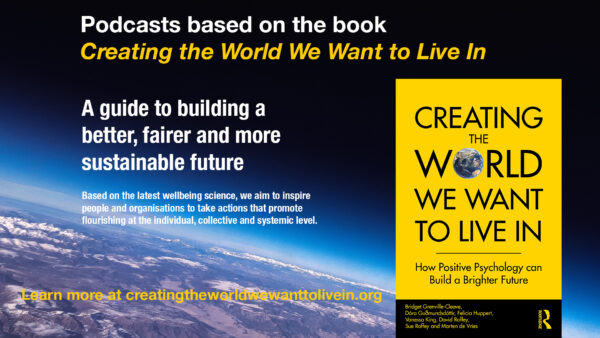
These podcasts are conversations around the subjects in the chapters of the book. The first two episodes are conversations between Professor Isaac Prilleltensky and Dr Sue Roffey on Childhood and Education. They are, in fact, two parts of one conversation, so probably best to listen to them in order!
Episode 1: Childhood and Episode 2: Education are available now on many podcast platforms – search for the Creating the World We Want to Live In podcast, or listen via Apple Podcasts at this link.
Episode 3: Economics and Politics – also a conversation, this time between Prof Isaac and David Roffey is also now available.
More episodes are planned for each month going forward.
NZ Mental Health in Schools conference, April 2022
This is Sue’s presentation, Social and Emotional Learning for School and Student Wellbeing, to the New Zealand Mental Health in Schools Conference on 8 April 2022.
The Mental Health in Schools Big Conversation: Week 1 – Support for Pupils
For Minds Ahead and The Carnegie Centre of Excellence for Mental Health in Schools at Leeds Beckett University.
Creating the World We Want to Live In book launch
Relationships in Education & Inclusive Schools

ASPIRE to wellbeing in school

This podcast talks about supporting the wellbeing of teachers and young people at a time of great change, challenge and uncertainty. Listen here: https://lnkd.in/eQw2b2V
Sue Roffey’s video for the UNESCO MGIEP Rethinking Learning book launch

Video recorded for UNESCO MGIEP: click on the pic above to play the video.
To find out more about the book, go to this link: Re-thinking Learning: A Review of Social-Emotional Learning for Education Systems.
Rethinking behaviour management in schools – Parts One & Two
Dr Sue Roffey, Dr Kulvarn Atwal and Dr Chris Bagley share their thoughts on the current behaviour management strategies adopted by many schools, and reflect upon the necessity to ensure that the child’s wellbeing and emotional needs are put at the centre of all policies. Watch Part One here, and Part Two here.
Teacher wellbeing in challenging times
Streamed live on 25 May 2020.
Dana and the Doom Merchant
Sue reads this Wellbeing Story to an online audience.
DANA AND THE DOOM MERCHANT addresses issues of loss and change. Dana has a history of successfully moving schools but now she is distraught because she is going to a different high school from her friends. This gives the Doom Merchant an opportunity to seed thoughts that things will never be good again. ZIP comes along and points out that the Doom Merchant is a fraud who takes away optimism and hope. Dana tells this story from the point of view of now being in High School where things have turned out OK.
School as Family: Education aligned with healthy child development
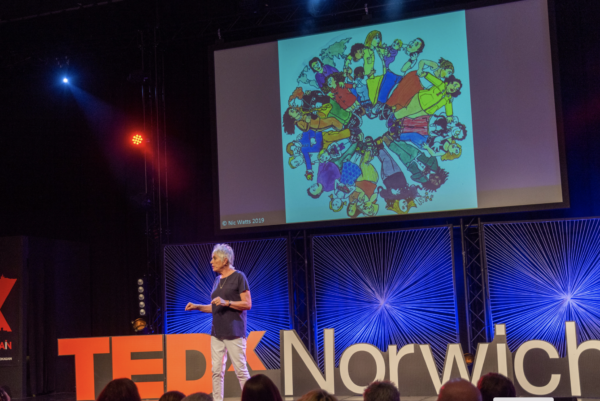
Sue Roffey’s TEDx Norwich talk: https://www.ted.com/talks/sue_roffey_school_as_family_education_aligned_with_healthy_child_development
Healthy child development includes the drive to discover, become independent, be active, connect with others and have fun. When schools promote an environment that fosters positive development, all pupils are more likely to thrive. Education that mirrors the best of family life puts wellbeing at its heart and includes learning to be and live together as well as knowledge and skills. This will not only reduce mental health concerns and enable young people to become the best of themselves, it will also empower future communities to flourish.
Why I believe Wellbeing should be at the heart of education
An interview with Sue Roffey on MyPOVonline.com
Part 1: https://mypovonline.com/sueroffey/activity/2045/
Includes Sue’s discussion of the ASPIRE principles (about 4 mins in from the start).
Part 2: https://mypovonline.com/sueroffey/activity/2056/
Part 3: https://mypovonline.com/sueroffey/activity/2081/
Part 4: https://mypovonline.com/sueroffey/activity/2106/
The Why What and How of a Healthy Relationship

Sue Roffey’s guest lecture at the University of Groningen in September 2017:
https://streaming3.service.rug.nl/p2gplayer/Player.aspx?id=dDLaS5
(This is 75 mins long!)
Circle Solutions
This photo-film shows Circles in action across the age range. We hear from teachers, students and school principals about the difference it is making for individuals, classes and school culture.
Click on the pic below to download the movie (329MB):

Aboriginal Girls Circle
Young Aboriginal Women are the hope of future communities. Watch this photo-film to see how the AGC connects high school girls, gives them a voice, grows leaders and ‘solutionaries’. The AGC, initiated by Sue Roffey, has been positively evaluated by Dr Brenda Dobia and her team at the University of Western Sydney.
To download the video (698MB), click here: AGC photofilm.
Mind & Its Potential, Sydney, 2014
Wellbeing begins with WE

This is Sue Roffey’s interview from the Fulfilling Lives Summit in May 2014. You can watch it by clicking on this link:
Sue Roffey: Wellbeing begins with WE (1 hour long – 281MB)
Publications by Our Partners
 The Educators’ Guide to Whole-school Wellbeing: A Practical Guide to Getting Started, Best-practice Process and Effective Implementation, by Denise Quinlan & Lucy Hone (2020), addresses challenges faced by schools wanting to improve wellbeing. While many schools globally now understand the need to promote and protect student wellbeing, they often find themselves stuck – not knowing where to start, what to prioritise, or how to implement whole-school change. This book fills that gap.
This book provides companionship through rich stories from schools around the world that have created wellbeing practices that work for their schools. It guides educators through processes that help create individualised, contextualised school wellbeing plans. With chapters addressing ‘why wellbeing?’, ‘what is “whole school?”’, change dynamics, measurement, staff wellbeing, coaching, cultural responsiveness, and how to build buy-in, it is the first of its kind. Balancing research and practice for each topic with expert practitioner and researcher insights, this book gives schools access to best-practice guidance from around the world in a user-friendly format, designed for busy educators.
How to do Restorative Peer Mediation in Your School: A Quick Start Guide including Online Resources , by Bill Hansberry and Christie-Lee Hansberry, Jessica Kingsley Publishing (2018).
This is a how-to guide to implementing a program of restorative peer mediation in schools. Using a proven approach to conflict resolution, this manual trains students to solve conflicts in the schoolyard and classroom by understanding peacefulness and restoration. A must-have resource for schools wishing to foster a culture of restorative justice.
This Quick-Start Manual contains:
- Suggested processes for selecting suitable students to be Restorative Peer Mediators
- Examples of correspondence to caregivers
- Guidance on implementing an RPM program into school policy
- Step by step notes and advice on running initial (phase 1) and ongoing (phase 2) mediator training,
- Reproducible training materials as available free online
- Scripts for Restorative Peer Mediators to use
This is a proven set of resources for making Restorative Peer Mediation part of your school’s wellbeing program.
 School Belonging in Adolescents: Theory, Research and Practice by Kelly Allen and Peggy Kern (2017). This book explores the concept of school belonging in adolescents from a socio-ecological perspective, acknowledging that young people are uniquely connected to a broad network of groups and systems within a school system. Using a socio-ecological framework, it positions belonging as an essential aspect of psychological functioning for which schools offer unique opportunities to improve. It also offers insights into the factors that influence school belonging at the student level during adolescence in educational settings. Taking a socio-ecological perspective and drawing from innovative research methods, the book encourages researchers interested in school leadership to foster students’ sense of belonging by developing their qualities and by changing school systems and processes
 Practising Positive Education: A Guide to Improve Wellbeing Literacy in Schools by Paula Robinson (2017). The Positive Psychology Institute and Knox Grammar School are proud to announce the launch of their foundational book on Positive Education. More than 300 pages of research, models, resources, evidence-based activities and stories from the front lines of education bring the theory and practice of Positive Education to life. Featuring contributions from international experts in the field, this practical and accessible book is for educators, leaders, parents, policy makers, community groups, schools and universities. Within its pages, summaries of international research findings are accompanied by powerful ideas and practical exercises to help you introduce Positive Education in your educational setting, home or workplace. Practising Positive Education: A Guide to Improve Wellbeing Literacy in Schools is the first in a series of hard and soft copy manuals, workbooks and texts spanning all aspects of Positive Education.
 A Practical Introduction to Restorative Practice in Schools: Theory, Skills and Guidance, by Bill Hansberry (2016)
Restorative Practices are not for the faint hearted. They demand that our work in schools be less political and more human. This demands that when things go wrong in schools that we empathise with students (and those who love them) and move into emotional spaces with them that we may not have occupied previously. Restorative practices are not discipline from a distance. They are up close, personal and at times confronting, which is at odds with the direction that many schools are taking their discipline systems. As communities become increasingly disconnected and fearful of one another, responses to conflict, harm and wrongdoing that bring people and their difficult emotions face to face can seem too risky for many, yet schools who have bravely embraced restorative practices have found that this is a risk well worth taking. This book contains an extremely comprehensive and detailed account of the ‘what’ and ‘how’ a school might do its restorative practice that I hope inspires (or re-inspires) teachers and school leaders to take the risk of building a more human and connected school.
 The Resilience Doughnut: The Secret of Strong Kids, by Lyn Worsley (2015)
Lyn has written this book in everyday useable language, making it an easy read, and a resource that can be used for anyone experiencing the difficulties that life inevitably brings. Children as young as 5 years old have used the Resilience Doughnut and understood what makes them strong!
The Resilience Doughnut: The Secret of Strong Adults, by Lyn Worsley (2015)
This book takes the doughnut to a new level – giving a practical tool for decision making, relationships. After many years of speaking to parents, teachers, youth workers and people involved in helping young people develop resilience, I have responded to the call to bring the Resilience Doughnut into the adult world. It seems that the Resilience Doughnut resonates with many adults, particularly those who have struggled during tough times and have not only survived but have grown as a result of their tough times. As adults, resilience is not set. It is a continual process and we can affect the changes that we need to make.
Better Than OK: Helping Young People to Flourish at School and Beyond , by Helen Street & Neil Porter (Eds.), Fremantle Press (2014)
This is a book of up-to-date strategies for helping children—from their earliest years into adulthood—and is all about helping kids do more than just survive; these are strategies to help kids flourish. These solution-focused and easy-to-read essays are by 27 of the world’s top experts in positive education. Learn to help children develop a lifelong love of learning with this practical and positive guide.
‘This book is full of strategies for parents and teachers wanting to help young people develop a lifelong love of learning.’ Child Magazine
 Raising Beaut Kids: Recipes for Parents on when to say ‘yes’ and how to say ‘no’, by Bill Hansberry and Mark LeMessurier.
If there’s a book that teaches restorative parenting, then this is it. We have captured approaches and strategies that exemplify authoritative parenting, that is parenting that is both firm and fair. The kind of parenting where kids feel in control of their choices because the behavioural boundaries are clearly communicated and lovingly enforced.
It’s cookbook-styled, with each chapter offering a typical problematic scenario that parents often face at home with their children and teens – accompanied with the ingredients that fire things up!
Then we offer a Recipe rescue as a problem solver: a practical way to respond to kids when they serve up tricky behaviours. Our Recipe rescues are designed to help parents steer the behaviour of their kids (and their own behaviour) in more positive directions, within the context of building healthy relationships.

Working Restoratively in Schools: A Guidebook for Developing Safe & Connected Learning Communities, by Bill Hansberry.
“Working Restoratively in Schools” has been written with an understanding of on-the-ground school discipline from a classroom and school administration level. Suitable from Kindy to Secondary, this guidebook addresses many of the questions that schools have about the ongoing and sustainable implementation of Restorative Justice (RJ). Divided into 4 sections, this guidebook covers a wide range of topics from the basics of RJ, through to school-wide processes for embedding RJ in policy and practice. Written by Bill Hansberry – a classroom teacher and consultant, and drawing on the expertise of other well respected educators and consultants, this is a must-have resource for any school or centre that is serious about developing safer and more connected learning communities.
2023: Sue Roffey: ASPIRE to a better future: The Impact of the Pandemic on Young People, and Options for Schools Post-COVID-19. Education Sciences, 2023, 13, 623
2021: Ziggi Ivan Santini, Veronica Pisinger, Line Nielsen, Katrine Rich Madsen, Malene Kubstrup Nelausen, Ai Koyanagi, Vibeke Koushede, Sue Roffey, Lau Thygesen & Charlotte Meilstrup: Social Disconnectedness, Loneliness, and Mental Health Among Adolescents in Danish High Schools: A Nationwide Cross-Sectional Study, Frontiers in Behavioral Neuroscience, 15
2019: Sue Roffey, Christopher Boyle & Kelly-Ann Allen: School belonging – Why are our students longing to belong to school?, Guest Editorial, Educational & Child Psychology, 36(2)
2019: Brenda Dobia, Roberto Parada, Sue Roffey & Madelaine Smith: Social and emotional learning: From individual skills to class cohesion, Educational & Child Psychology, 36(2)
2018: Liz Robson-Kelly: ‘Is positive education too positive for the UK? Do we require a more nuanced approach to positive education in the UK?’, European Journal of Applied Positive Psychology, 2(4): 1-5.
2018: Helen Street: Contextual Wellbeing: Creating healthy school contexts from the inside out
2017: Sue Roffey: The ASPIRE Principles and Pedagogy for the Implementation of Social and Emotional Learning and the Development of Whole School Well-Being, in International Journal of Emotional Education, 9(2): 59-71
2017: Sue Roffey: ‘Ordinary magic’ needs ordinary magicians: The power and practice of positive relationships for building youth resilience and wellbeing, in Kognition & Pædagogik 103 (Spring 2017) – Danish version can be found here: http://dpf.dk/produkt/tidsskrift/kognition-paedagogik-nr-103
2016: Kelly Allen: Pathways to school belonging in The Educational and Developmental Psychologist 33 (1)
2016: Sue Roffey: Building a case for whole-child, whole-school wellbeing in challenging contexts, in Educational and Child Psychology 33 (2)
2016: Anne Greig, Tommy MacKay, Sue Roffey & Antony Williams: Guest editorial: The Changing Context for Mental Health and Wellbeing in Schools in Educational and Child Psychology 33 (2)
2015: Sue Roffey: Becoming an agent of change for school and student wellbeing, in Educational and Child Psychology 32 (1)
2014: Anne Greig, Charmian Hobbs & Sue Roffey: Education & Child Psychology, 31(1), Empowering Young People: Editorial
2014: Brenda Dobia, Gawaian Bodkin-Andrews, Roberto Parada, Virginia O’Rourke, Shirley Gilbert, Annie Daley & Sue Roffey: Aboriginal Girls Circle: enhancing connectedness and promoting resilience for Aboriginal girls: Final Pilot Report
2013: Sue Roffey & Florence McCarthy: Circle Solutions: a philosophy and pedagogy for learning positive relationships. What promotes and inhibits sustainable outcomes? in International Journal of Emotional Education, 5 (1) 36-55
2013: Sue Roffey: Inclusive and exclusive belonging – the impact on individual and community well-being, in Educational and Child Psychology 30 (1)
2012: Sue Roffey: Pupil wellbeing – Teacher wellbeing: Two sides of the same coin? in Educational and Child Psychology 29 (4)
2011: Wendy Madden, Suzy Green & Anthony Grant: A pilot study evaluating strengths-based coaching for primary school students: Enhancing engagement and hope, in International Coaching Psychology Review 6 (1)
2011: Sue Roffey: Enhancing Connectedness in Australian Children & Young People in Asian Journal of Counselling, 18 (1 & 2) 15-39. Reprinted here with permission from AJC.
2010: Sue Roffey: Content and context for learning about relationships: A cohesive framework for individual and whole school development in Educational and Child Psychology 27 (1). Sue co-edited this special issue on In-school Relationships and their Outcomes. You can download all 12 articles here.
2009: Robyn Hromek & Sue Roffey: Games as a pedagogy for social and emotional learning. ‘Its fun and we learn things’ Simulation and Gaming 40 (5) 626 – 644
2008: Toni Noble, Helen McGrath, Sue Roffey & Louise Rowling: A Scoping Study on Student Wellbeing Department of Education, Employment & Workplace Relations (DEEWR), Australian Commonwealth Government
2008: Sue Roffey: Emotional literacy and the ecology of school wellbeing in Educational and Child Psychology 25 (2) 29-39
Sue co-edited this special issue on Psychological Wellbeing.
2007: Sue Roffey: Transformation and emotional literacy: The role of school leaders in developing a caring community, in Leading and Managing 13 (1) 16 – 30
2005: Sue Roffey: Respect in Practice: the challenge of emotional literacy in education. Peer reviewed paper for AARE conference (Australian Association for Research in Education)
2005: Sue Roffey & Michelle Nemec: Emotional literacy and whole school change. Australian Association for Research in Education.
2004: Sue Roffey: The home-school interface for behaviour: A conceptual framework for co-constructing reality, in Educational and Child Psychology 21 (4) 95-108
2000: Sue Roffey: Addressing Bullying: Organisational Factors from Policy to Practice in Educational and Child Psychology 17 (1)
1997: Sue Roffey, Tony Tarrant & Karen Majors: Friends, who needs them? in Educational and Child Psychology 14
2021: Ziggi Ivan Santini, Veronica Pisinger, Line Nielsen, Katrine Rich Madsen, Malene Kubstrup Nelausen, Ai Koyanagi, Vibeke Koushede, Sue Roffey, Lau Thygesen & Charlotte Meilstrup: Social Disconnectedness, Loneliness, and Mental Health Among Adolescents in Danish High Schools: A Nationwide Cross-Sectional Study, Frontiers in Behavioral Neuroscience, 15
2019: Sue Roffey, Christopher Boyle & Kelly-Ann Allen: School belonging – Why are our students longing to belong to school?, Guest Editorial, Educational & Child Psychology, 36(2)
2019: Brenda Dobia, Roberto Parada, Sue Roffey & Madelaine Smith: Social and emotional learning: From individual skills to class cohesion, Educational & Child Psychology, 36(2)
2018: Liz Robson-Kelly: ‘Is positive education too positive for the UK? Do we require a more nuanced approach to positive education in the UK?’, European Journal of Applied Positive Psychology, 2(4): 1-5.
2018: Helen Street: Contextual Wellbeing: Creating healthy school contexts from the inside out
2017: Sue Roffey: The ASPIRE Principles and Pedagogy for the Implementation of Social and Emotional Learning and the Development of Whole School Well-Being, in International Journal of Emotional Education, 9(2): 59-71
2017: Sue Roffey: ‘Ordinary magic’ needs ordinary magicians: The power and practice of positive relationships for building youth resilience and wellbeing, in Kognition & Pædagogik 103 (Spring 2017) – Danish version can be found here: http://dpf.dk/produkt/tidsskrift/kognition-paedagogik-nr-103
2016: Kelly Allen: Pathways to school belonging in The Educational and Developmental Psychologist 33 (1)
2016: Sue Roffey: Building a case for whole-child, whole-school wellbeing in challenging contexts, in Educational and Child Psychology 33 (2)
2016: Anne Greig, Tommy MacKay, Sue Roffey & Antony Williams: Guest editorial: The Changing Context for Mental Health and Wellbeing in Schools in Educational and Child Psychology 33 (2)
2015: Sue Roffey: Becoming an agent of change for school and student wellbeing, in Educational and Child Psychology 32 (1)
2014: Anne Greig, Charmian Hobbs & Sue Roffey: Education & Child Psychology, 31(1), Empowering Young People: Editorial
2014: Brenda Dobia, Gawaian Bodkin-Andrews, Roberto Parada, Virginia O’Rourke, Shirley Gilbert, Annie Daley & Sue Roffey: Aboriginal Girls Circle: enhancing connectedness and promoting resilience for Aboriginal girls: Final Pilot Report
2013: Sue Roffey & Florence McCarthy: Circle Solutions: a philosophy and pedagogy for learning positive relationships. What promotes and inhibits sustainable outcomes? in International Journal of Emotional Education, 5 (1) 36-55
2013: Sue Roffey: Inclusive and exclusive belonging – the impact on individual and community well-being, in Educational and Child Psychology 30 (1)
2012: Sue Roffey: Pupil wellbeing – Teacher wellbeing: Two sides of the same coin? in Educational and Child Psychology 29 (4)
2011: Wendy Madden, Suzy Green & Anthony Grant: A pilot study evaluating strengths-based coaching for primary school students: Enhancing engagement and hope, in International Coaching Psychology Review 6 (1)
2011: Sue Roffey: Enhancing Connectedness in Australian Children & Young People in Asian Journal of Counselling, 18 (1 & 2) 15-39. Reprinted here with permission from AJC.
2010: Sue Roffey: Content and context for learning about relationships: A cohesive framework for individual and whole school development in Educational and Child Psychology 27 (1). Sue co-edited this special issue on In-school Relationships and their Outcomes. You can download all 12 articles here.
2009: Robyn Hromek & Sue Roffey: Games as a pedagogy for social and emotional learning. ‘Its fun and we learn things’ Simulation and Gaming 40 (5) 626 – 644
2008: Toni Noble, Helen McGrath, Sue Roffey & Louise Rowling: A Scoping Study on Student Wellbeing Department of Education, Employment & Workplace Relations (DEEWR), Australian Commonwealth Government
2008: Sue Roffey: Emotional literacy and the ecology of school wellbeing in Educational and Child Psychology 25 (2) 29-39
Sue co-edited this special issue on Psychological Wellbeing.
2007: Sue Roffey: Transformation and emotional literacy: The role of school leaders in developing a caring community, in Leading and Managing 13 (1) 16 – 30
2005: Sue Roffey: Respect in Practice: the challenge of emotional literacy in education. Peer reviewed paper for AARE conference (Australian Association for Research in Education)
2005: Sue Roffey & Michelle Nemec: Emotional literacy and whole school change. Australian Association for Research in Education.
2004: Sue Roffey: The home-school interface for behaviour: A conceptual framework for co-constructing reality, in Educational and Child Psychology 21 (4) 95-108
2000: Sue Roffey: Addressing Bullying: Organisational Factors from Policy to Practice in Educational and Child Psychology 17 (1)
1997: Sue Roffey, Tony Tarrant & Karen Majors: Friends, who needs them? in Educational and Child Psychology 14

Strengths in Circles cards – Sue Roffey and Russell Deal
Discover what many indigenous communities have known forever: sitting in a circle with others and establishing simple, respectful guidelines for communicating might just be the most effective solution-finding technique ever invented!
The Circles approach to groups and teams is safe, respectful, democratic, inclusive and strengths-based. Each Strengths in Circles card contains a building block for putting Circles into practice – in schools, teams, organisations and communities.
42 cards arranged into 6 suits based on the ‘ASPIRE’ acronym:
- Agency
- Safety
- Positivity
- Inclusion
- Respect
- Equality
Each theme names 7 key values that can be discussed, interpreted and considered for adoption as ground rules by any group. Watch the dynamics of the group evolve within the sphere of these values!
These cards are now only available in digital form, and will be replaced quite soon by the new ASPIRE culture cards. Meanwhile, you can buy the digital versions here: innovativeresources.org/resources/card-sets/strengths-in-circles/
‘I wholeheartedly recommend this card set, particularly to educators. I hope it will find its place in schools to give guidance and focus to the strengths advocated in this incisive and exemplary resource.’ Bill Rogers PhD, educationalist

Early Years Restorative Conference Script Cards – Developed by Jane Langley and Bill Hansberry for the Early Years
These high colour, pocket-sized cards contain easy to follow restorative conference scripts that have been modified from the ‘grown up’ (standard) restorative script. These individual and small group scripts have been developed for use with early years children and/or children with language difficulties.
Many children don’t have the language development needed to engage with standard conference scripts. These kids need shorter (less wordy), more concrete questions. These scripts lessen the receptive language demands so children are more able to focus on what happened, their feelings, other peoples’ feelings and ways the problem might be sorted out.
These scripts are the result of years of trial and error in early years settings and are our best effort to assist our early years colleagues to develop childrens’ empathic awareness of others, sooner rather than later.
Buy them here: hansberryec.com.au/index.php?action=home&pageid=45
The Grab and Go Circle Time Kit for Teaching Restorative Behaviour: 13 sessions for Junior Primary, by Bill Hansberry and Jane Langley
 Thinking and Behaving Restoratively doesn’t come naturally to all kids. Restorative Practices is a way of thinking about people and events and it’s a frame of reference that we can teach to young people. What’s the result? Calmer, more peaceful and more productive classrooms and playgrounds. Evidence shows that schools that actively teach Restorative Thinking and Behaviour to students report less bullying behaviour, less anxious kids, less anxious parents and happier teachers.
The Grab and Go Circle Time Kit for Teaching Restorative Behaviour is unique. We’ve harnessed the Circle Time pedagogy, (also known as Circle Solutions) to create thirteen wonderful sessions to actually teach Junior Primary Students how to think and behave restoratively. Packed with wonderful illustrated stories and resources for use in the sessions, busy teachers can literally pick this manual up and run with it!