

 Although most pupils are doing OK, we have a mental health crisis impacting on a significant number of children and young people. Schools can either exacerbate the difficulties or ameliorate them. Schools that are doing well for all the children and young people in their care are concerned about more than academic success. They want pupils to enjoy learning, feel they can be successful and know that people care about them. Published in 2024 by Routledge, these two books – ASPIRE to wellbeing and learning for all in early years and primary and ASPIRE to wellbeing and learning for all in secondary settings – show education practitioners how to help every student feel valued and included in school, so they develop confidence, resilience, love of learning, a positive sense of self and healthy relationships.
Sue Roffey presents a visionary and unique approach to education, underpinned by clear principles that can be practically applied in all settings. It is aligned with what we know promotes healthy child development and addresses what all children need if they are to learn and thrive, including those who experience difficulties and disadvantages. She envisages an education system fit for purpose where all pupils can thrive and make progress in learning, where wellbeing for everyone is at the heart of every school. She uses ASPIRE as an acronym for Agency, Safety, Positivity, Inclusion, Respect and Equity. These principles, when threaded through everything that happens in a school, can genuinely enhance both wellbeing and learning. This resource features a chapter for each principle which explores what this means, why it matters and how it can be applied. Although visionary, the books are based on both substantial evidence and good practice, with each chapter supported by case-studies across the world.
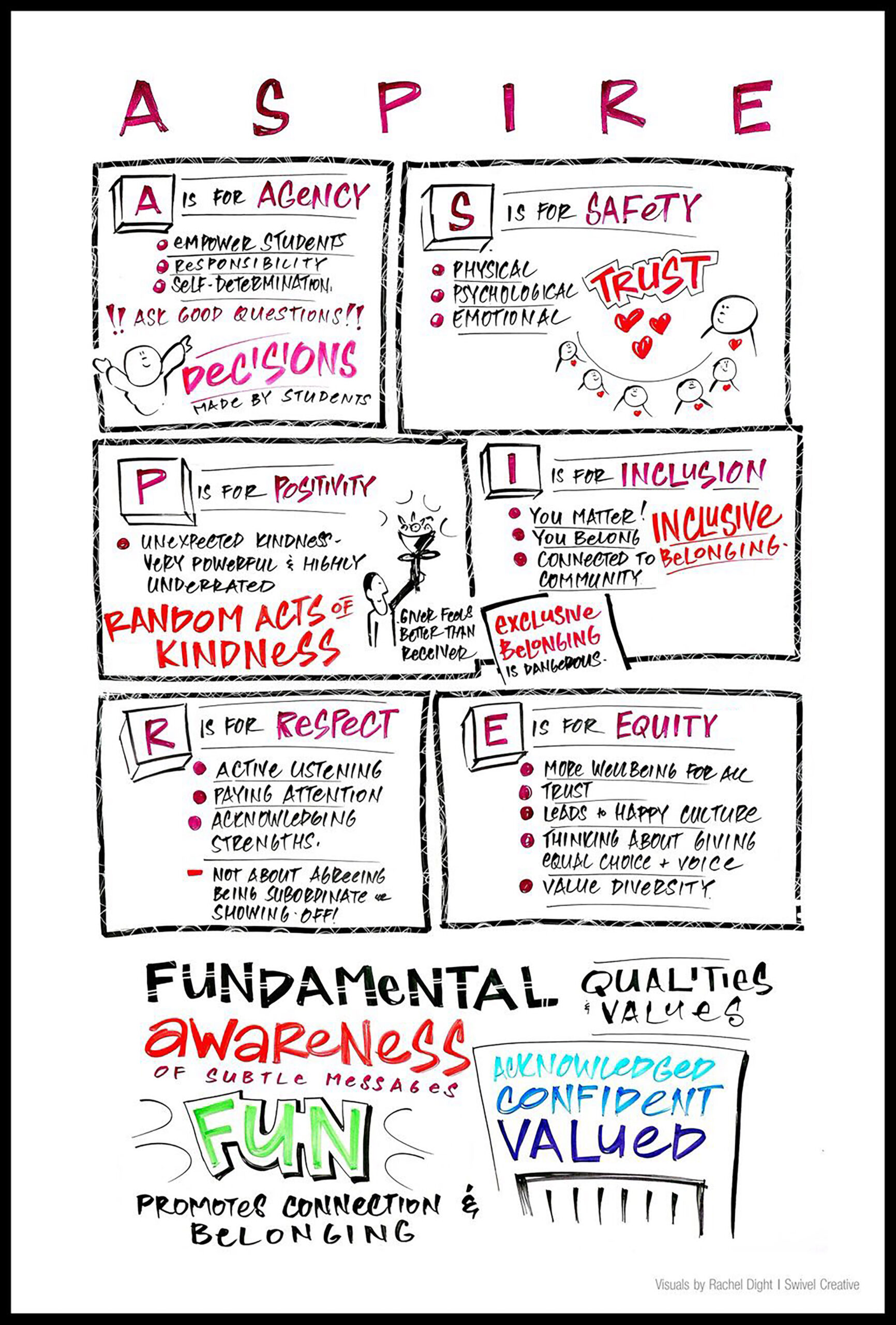
The Principles
Although described separately these principles interact to promote optimal relationships with colleagues and clients. Read more about each principle or read an excerpt from the chapters by clicking on the links.
Agency
When people have agency they have choices and take responsibility for making things happen. When we work with schools, classes, teachers, students or parents, we do not impose answers, but help people come to their own decisions about ways forward. We do this by providing information, guidance, ideas, evidence and supporting strategic thinking. We see our work as a co-operative endeavour. Read more about Agency. Read an excerpt from the chapter.
Safety
Relationships are central to our work. In a healthy relationship everyone feels emotionally, physically and psychologically safe. Without this people cannot take risks for fear of making mistakes. Safety also implies trust. We will not offer what we cannot deliver, but may find someone who can. Read more about Safety. Read an excerpt from the chapter.
Positivity
Our work is based in positive psychology and positive education. Our major focus is helping people define their vision and goals and the steps towards these – this is different from dealing primarily with problems. We explore the strengths that people, organisations and families have and build on these. We also bring a light touch into our work with the positive psychology aspects of kindness, gratitude, humour and positive communication. Read more about Positivity. Read an excerpt from the chapter.
Inclusion
A sense of belonging is critical for wellbeing. This means that we value diversity – everyone has something to offer. One aspect of inclusion is cooperation. To facilitate this we encourage participants in any project to get to know each other, to break up cliques, help with communication and facilitate new perspectives. Read more about Inclusion. Read an excerpt from the chapter.
Respect
When people ask how they want to be treated by others, most say they want to be respected. When asked to define what respect means for them, they say being accepted, being listened to, not being judged, having confidences kept. We also believe that it means respecting people’s time and circumstances. Respect does not only apply to individuals, it also applies to contexts and culture. Read more about Respect. Read an excerpt from the chapter.
Equity
Equity means that everyone in a project has an equal voice. No-one dominates and the aim is to come to a consensus. We appreciate that in order to ensure equity we may need to have flexibility in our approach. Read more about Equity. Read an excerpt from the chapter.