

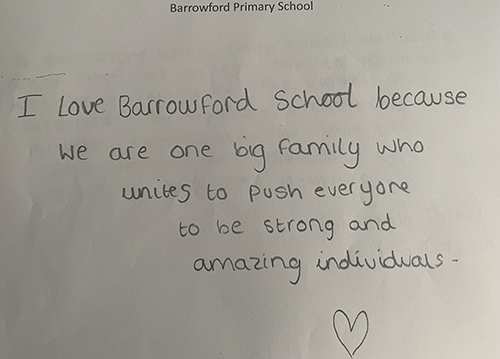
Learn to Love, Love to Learn
Barrowford School doesn’t have a behaviour policy, it has a ‘relationships policy’. ‘Learn to love – love to learn’ is boldly written everywhere. Children feel safe, wanted and loved in school no matter what transpired in their early years, or what trauma they have experienced. They know the adults care about them and will work with both them and their families to help them learn all they can and become happy and successful human beings. These values are shared by all who work at Barrowford.
Staff are adamant that emotional safety is not a preface to ‘real’ learning but part of its substance. Pupils must ‘learn to love’ school before they can fully engage with formal content. For some children learning about ‘rivers and geography’ cannot compete with the immediate need to feel safe, known and regulated. Relationships are a core strength, with adults prioritising trust over throughput. The message is consistent: emotional well-being is not a soft alternative to standards, but the primary condition under which demanding learning becomes possible for all.
Curriculum
Although learning at Barrowford is mapped against the National Curriculum, it is built around meaningful projects involving people, places and a problem. Enquiry-based projects begin with compelling questions inviting multi-disciplinary investigation, discussion and critical thinking. Every project has a values-based dimension encouraging children to consider responsibility, justice and sustainability.
Lots of our projects are built around a story and a person, so there’s a real context and a reason to learn. Children are asked, ‘What would you do if you were in that situation?’ It makes learning real, rather than just content. (teacher)
Not only do children learn more in the project approach, they become better learners by understanding that learning is there for us to solve problems and that’s what life’s about. (teacher)
Inclusion
The staff at Barrowford have a long-standing commitment to working with vulnerable children whose lives are shaped by trauma, domestic abuse, addiction and parental mental health difficulties. Children’s behaviour is understood through the context of their lives rather than viewed as a discipline or learning problem.
58.5% of the school population are boys, with significant numbers arriving after exclusion or ‘managed moves’ from other schools. 41.2% are from a minority ethnic background, many recently arrived in the country. 44% have free school meals. 36.9% of pupils are persistently absent (i.e. missing more than 10% of sessions. see below), 34.3% have SEND with 17.6% having an Education Health and Care Plan. There is a very wide range of specific needs: the largest numerically are autistic spectrum disorders, speech language and communication needs, and social, emotional and mental health needs; in addition there are significant numbers with physical disabilities and learning difficulties.
The school understands that if children have struggled with learning and/or behaviour, it is because their needs have not yet been fully met.
Barrowford has developed an integrated support network that brings together safeguarding, SEND provision, therapy and family support. Key staff include a full-time SENDCo, a qualified social worker and a play therapist. This joined-up approach enables regular communication and close collaboration between everyone involved with the child and family.
Flexi-schooling: trusting families
Most families choosing flexi-schooling have been home-educating their children and looking for a school that shares their values. They are not seeking less education but a different balance. They want their children to experience the rich curriculum, social opportunities and specialist teaching that the school provides while retaining the freedom to pursue learning beyond the classroom. Rather than forcing families into an all-or-nothing choice, the school has created a genuinely hybrid model.
Every arrangement is negotiated individually. Some children attend three days a week, others four. Some attend mornings only, while others spend Fridays learning with their families through travel, outdoor education, creative projects or experiences that would be difficult to replicate within school. The timetable is not designed to suit the school; it is designed to suit the child.
National attendance systems are, however, inflexible, making little allowance for this kind of personalised provision. Because there is no attendance code that reflects flexi-schooling, these pupils are recorded as absent for the periods when they are learning elsewhere, despite following an agreed educational programme. The school’s attendance figures therefore appear significantly weaker than the reality. For many schools this would be reason enough not to pursue the approach. Here, it is accepted as the cost of doing what leaders believe is right for children.
One of the things the inspectors kept saying to us was, ‘You don’t have to do this, Rachel. You don’t have to say yes to parents when they ask.’ I was like, ‘Oh, … but why would I not? Why would a parent come in to me and say, we want this hybrid model for our children – why would we not do that?’ Because those kids bring such a lot to our school in terms of their other experiences, and they’re really engaged learners … our most engaged core of learners, because they’re just learning all the time. (Rachel)
Conclusion
We set out to find ten exceptional schools where a love of learning is deeply evident. Barrowford meets that standard with distinction. Its leadership, staff commitment to children’s welfare and learning, rich curriculum, and wide-rangingprovision for diverse needs offer a compelling model of what every school could aspire to be.
Barrowford School makes everyone confident and love their true selves. (pupil)
If Ofsted don’t like what they’re doing, then Ofsted needs to change its rules … or its criteria for excellence, because this school is loved and it’s enjoyable … I barely recognise the school from the Ofsted report. (parent)
Sue Egersdorff runs Ready Generations, a nursery based in a residential, care and nursing home. She and Rachel have collaborated on intergenerational learning, and Sue has visited the school many times:
The solidarity of the school’s vision, culture and spirit is extraordinary, especially in these times of increasing fragmentation and discord … This is deep work, often with life changing outcomes for children facing the most complex challenges … Barrowford operates from the heart … love bundled up with compassion, empathy and above all, an unconditional respect for the intrinsic worth and dignity of every child and adult … This experience of being held securely and lovingly increases a sense of personal identity, responsibility and accountability, not only to themselves and their peers but much more widely as innovators, leaders and influencers on a national and global stage. (Sue Egersdorff, Co-Founder, Ready Generations charity)
Jim Knight, former Minister of State for Schools, who has also visited the school several times, gave us this testimonial:
Barrowford is the best example I know of a school that rigorously tries to wrap learning around every child. The staff go to great lengths to understand each child, as humans and not just learners. The children feel heard and loved and this transfers to their learning… Go to where the child is and take the learning to them… this designs out disengagement, and it is hugely successful as a result. It is really hard work and not for the faint hearted. (Rt Hon Lord Knight of Weymouth)
There will be much more information about this and the other nine schools in the project in the forthcoming (2027) book, Inspiring Children’s Love of Learning: Exceptional Practice in Primary Schools (Routledge).





Leave A Comment
You must be logged in to post a comment.