

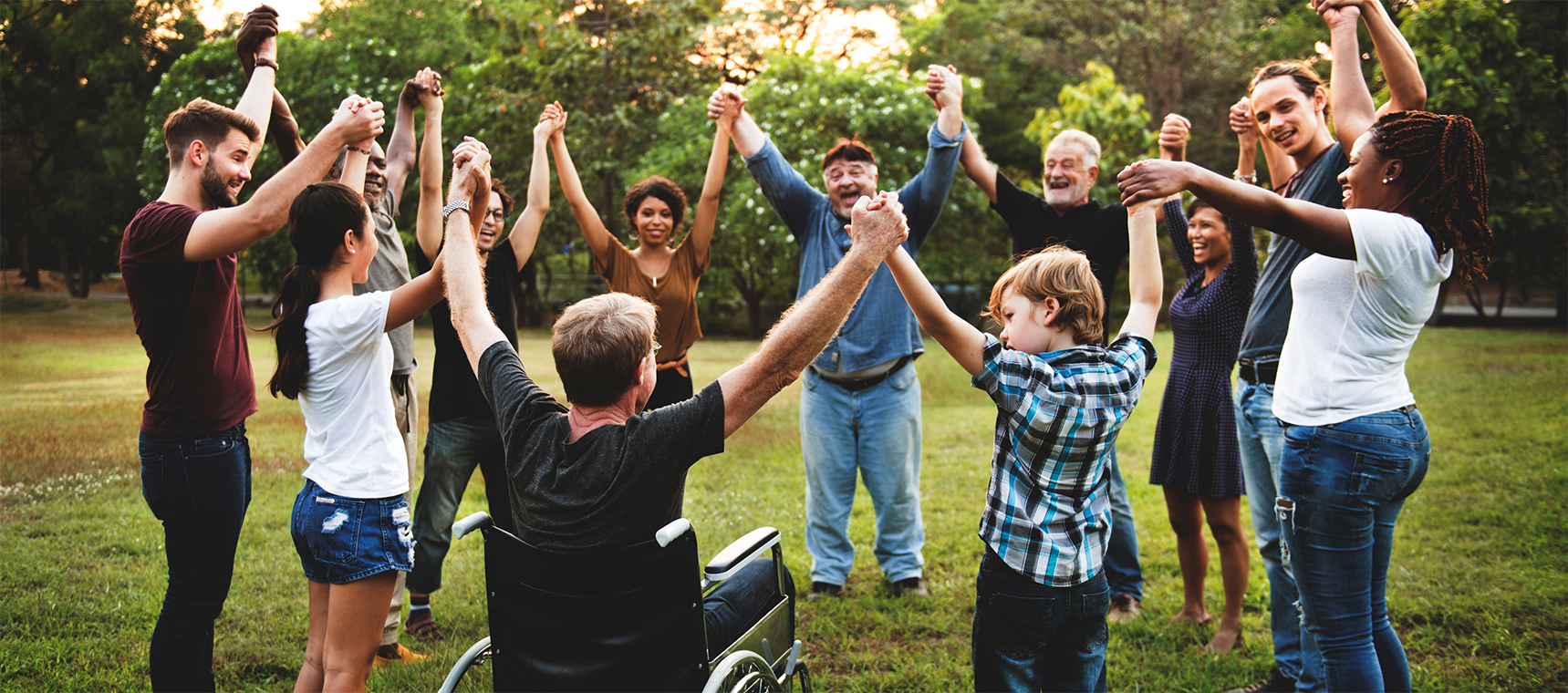
For most of us community “feels good”. Throughout history people have created diverse communities from virtual to face-to-face. They are today best characterized as a group of people that have common interests, purpose or needs. Communities may also be dramatically repressive and vulnerable, but they have largely provided a safety net when things go wrong, a place to grow and maintain social relationships throughout the life cycle. These key elements for wellbeing, evident across cultures and time, were visible during the COVID-19 pandemic lockdown. The pandemic lit up the positive role of community interaction in our lives, as social life became more local, increasingly neighbourhood- and virtual community centred.

Communal thinking is also challenged by unpredictable environmental events, transient lifestyles, cultural mixing and the trade-off between belonging, and the seeking of personal identity, leaving some communities increasingly characterized by loneliness and isolation. Community vulnerability, as well as supportive factors such as open communication, neighbourhood interaction, storytelling and group positive appraisal, forms the basis of effective communities. Street, ethnic and mainstream community examples of personal leadership, innovative local/neighbourhood groups, and/or governmental stimulation can create hope, communal action and create political power. If we can protect the positive functions of community in its various and changing forms, we will assist with improving quality of life and wellbeing for many in our dynamic world.

Marten de Vries (1996) Trauma in cultural perspective. In Bessel van der Kolk, Alexander McFarlane & Lars Weisaeth (Eds.), Traumatic stress: The effects of overwhelming experience on mind, body, and society (p. 398–413). The Guilford Press.

Building flourishing communities from the inside out

Achieving flourishing communities

  • [Street party] – personal experience of Sue & David Roffey (we were there!)
  • Salvatore Di Martino, Francisco José Eiroa-Orosa & Caterina Arcidiacono (2017). Community psychology’s contributions to happiness and well-being. In Nicholas Brown, Tim Lomas & Francisco Jose Eiroa-Orosa (Eds.). The Routledge International Handbook of Critical Positive Psychology (351–367). Routledge
  • Vanessa King (2016) 10 Keys to Happier Living. Action for Happiness.
  • Christian Krekel, Jan-Emmanuel De Neve, Daisy Fancourt & Richard Layard (2020), A Local Community Course that Raises Mental Wellbeing and Pro-Sociality, Discussion Paper, Centre for Economic Performance, London School of Economics and Political Science, January 2020. ISSN 2042–2695
  • BBC Storyville (2021) I am Greta. [No longer available on BBC iPlayer]
  • Arnold van Gennep (1909/2019) The Rites of Passage (Second Edition). (Translated by Monika Vizedom & Gabrielle Caffee) University of Chicago Press
  • John Janzen (1982) Drums Anonymous: Towards an Understanding of Structures of Therapeutic Maintenance. In Marten de Vries, Robert Berg & Mack Lipkin Jr. (Eds.), The Use and Abuse of Medicine, (154–66). Praeger.
  • Joseph Lash (1980) Helen and Teacher: The Story of Helen Keller and Anne Sullivan Macy. p. 489, Delacorte Press/Seymour Lawrence.

What is community?

Why community matters

The vulnerability of communities in today’s world

Family and community

The impact of external forces on community cohesion

Rahwa Ghirmatzion & Zelalem Adefris (2020) Community Powered Solutions to the Climate Crisis. TED.

Wale Elegbede (2020) It takes a Community to eradicate hate. TED.

Ben Wellington (2015) Making data mean more through storytelling. TEDx Broadway.

Cormac Russell (2016) Sustainable community development: from what’s wrong to what’s strong. TEDx Exeter.

Akanksha Wakhare (2018) Community Participation and Planning.

Stephen Jon Thompson (2016) Creating A Community And Finding Purpose. TEDx Carson City.

The Source for young people in Suffolk (2015) What is Community? Suffolk County Council.

Zygmunt Bauman (2015) From Privacy to Publicity. re:publica.